What Happened
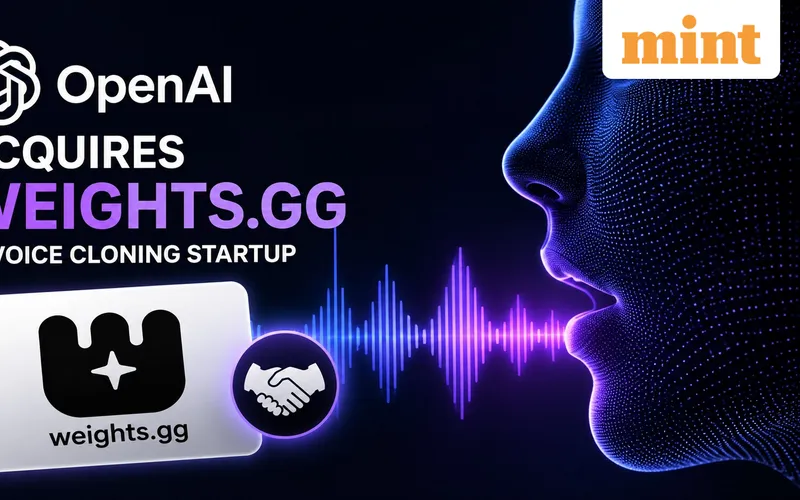
The short version is this: The New York Times reported that OpenAI quietly acquired WeightsGG, a startup focused on AI voice cloning. It was not a loud keynote moment. It was a strategic move that says a lot about where OpenAI is heading.
WeightsGG was not a household brand, but it had real traction in the part of the market that matters: people actually shipping voice products. If you build creator tools, support automation, or agent workflows, voice cloning is no longer a novelty feature. It is core product infrastructure.
So this deal is less “OpenAI bought a cool startup” and more “OpenAI is locking down a critical layer of the stack.”
Why This Matters More Than It Looks
Most people still think of OpenAI as a model company: text generation, chat interfaces, and APIs. But this acquisition is a strong signal that OpenAI wants to be a full-stack platform where text, voice, and eventually video are tightly integrated inside one ecosystem.
In practical terms, OpenAI now has more control over the pipeline from GPT prompt to generated speech output. That means better latency tuning, better reliability, and tighter product integration. It also means fewer dependency risks from third-party voice providers.
In platform strategy language, this is vertical integration. In plain language, OpenAI is trying to own more of the plumbing so developers have fewer reasons to leave.
The Real Business Signal: AI Consolidation Is Accelerating
If you are a founder building in voice AI, this is the signal you cannot ignore: the frontier layer is consolidating fast. Big labs are no longer content to be “model providers.” They are buying and building downstream capabilities that used to be startup territory.
That changes startup math. Your old plan might have been: build a voice layer, connect to a frontier model, and monetize feature depth. The new reality is harsher: either become so good that a platform buys you, or prepare to compete directly with deeply integrated first-party features.
This is classic AI consolidation. Big players can bundle voice AI into existing developer distribution, enterprise contracts, and consumer products. Startups without distribution get squeezed even if their tech is good.
What It Means for Product Teams Right Now
If you run product at a mid-size company, this is not abstract industry news. It affects your roadmap decisions immediately.
First, if your voice feature depends on external providers, revisit your vendor concentration risk. If one platform controls both intelligence and voice technology, your cost and switching options can change quickly.
Second, if you are comparing platform choices, evaluate ecosystem lock-in more aggressively. It is not just model quality anymore. It is end-to-end capability: text, speech, agent tooling, compliance posture, and deployment flexibility.
Third, if you are in sectors like customer support, sales, property operations, or recruiting, voice is becoming a default UX layer. That includes categories adjacent to an ai answering service, ai property management software, and ai hiring tools where speech workflows can reduce response time and improve conversion.
Regulatory and Competitive Fallout
The regulatory angle is huge. Voice cloning touches consent, identity misuse, fraud risk, and deepfake policy. A major AI lab owning both model intelligence and cloning infrastructure will draw attention from policymakers who already worry about concentration and abuse potential.
Expect questions around safeguards: how voices are verified, how misuse is prevented, what audit trails exist, and how users can report impersonation. Regulators are increasingly less interested in “we’ll moderate later” answers.
Competitive pressure also ramps up. Rivals now have to respond with either better speech quality, lower latency, stronger enterprise controls, or a clearer neutrality story. Everyone in voice AI just got dragged into a higher-stakes product race.
How to Think About This as a Founder
If you are building a voice startup, I would stop pretending generic “voice cloning API” positioning is enough. It is not. You need one of three defensible positions fast.
Position one: own a niche workflow where domain expertise matters more than generic model capability. Think regulated onboarding calls, healthcare intake protocols, multilingual legal intake, or construction coordination workflows where context matters more than raw speech generation.
Position two: win on trust and governance. Deep controls, consent architecture, watermarking, forensic traceability, and enterprise-grade admin tooling can still differentiate you against big-platform defaults.
Position three: be the neutral orchestration layer across providers. Companies doing serious ai consulting work often want optionality, not lock-in. If you can make multi-model voice deployment easy and measurable, that is still valuable.
And yes, this is where odd SEO terms like ai construction workflow vs bridgit.com can become real market intent. People are searching for vertical AI workflow outcomes, not just “best model.” That is where independent products can still win.
What to Do About It (Action Plan)
If you are a buyer, run a 30-day voice stack audit. Map where your speech pipeline depends on one vendor, where consent controls are weak, and where you lack fallback options.
If you are a founder, tighten your narrative from “we do voice AI” to “we solve this expensive operational problem with measurable outcomes.” Distribution and differentiation now matter more than raw demo quality.
If you are a growth team, update your content and demand strategy around practical use cases, not model fandom. Decision-makers care about conversion lift, call resolution time, fraud reduction, and customer retention.
If you are a policy or legal lead, assume enforcement pressure increases over the next year. Get your voice governance house in order before customers ask hard questions in procurement.
Bottom Line
OpenAI’s WeightsGG acquisition is not just another M&A line item. It is a strategic signal that the race has moved from “best model output” to “who owns the full delivery pipeline.”
For users, this could mean better integrated voice experiences. For builders, it means tougher platform dynamics and faster AI consolidation. For the market, it means voice AI is no longer a side quest. It is becoming core infrastructure in the GPT-era stack.
If you build products in this space, the message is blunt: plan for a world where frontier labs are your supplier, your competitor, and your potential acquirer at the same time.
Now you know more than 99% of people. — Sara Plaintext