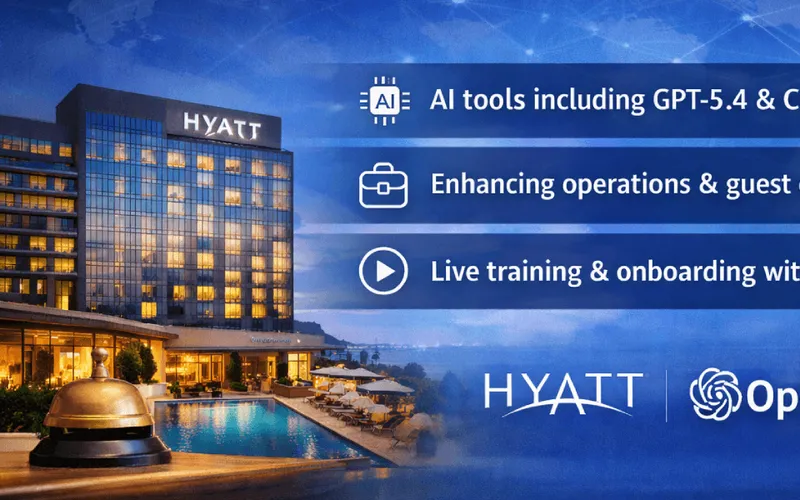
Here’s the hot take: Hyatt didn’t just buy an AI tool, it picked a side in the new operating-system war for enterprise work. Rolling out ChatGPT Enterprise across a global corporate and hotel workforce means AI is no longer the innovation team’s pet project; it’s now part of daily execution where guest experience, margins, and speed all collide.
I’m giving this move an overall score of 8.4/10. It deserves real credit for scale, ambition, and cross-functional intent. But let’s not pretend this announcement gave us all the proof we need. The strategy is strong; the evidence is still mostly directional.
Strategic Ambition: 9.1/10. Hyatt is making the classic smart enterprise play: deploy broadly, train aggressively, and attach AI to mission-critical workflows, not just “fun experiments.” Finance, marketing, operations, product, engineering, and customer experience are all named in the rollout. That’s exactly how you avoid AI becoming a novelty Slack bot and instead turn it into an institutional habit.
Execution Clarity: 7.6/10. The announcement says Hyatt collaborated with OpenAI on live onboarding and training, which is genuinely the difference between “licenses sold” and “tools actually used.” But the comms still read like a corporate highlight reel. I want hard numbers: cycle time reduced by what percent, report accuracy improved by how much, content throughput up by how many assets per team, and where the first measurable wins landed.
Tech Stack Power: 8.8/10. Giving employees access to frontier capabilities like GPT 5.4 and Codex inside an enterprise environment is a real unlock. In theory, that means analysts can summarize giant data dumps faster, marketers can ship campaign variants without burning out, and engineering teams can move from ticket to shipped feature with fewer dead hours in between. The upside is massive because hospitality is operations-heavy, communication-heavy, and latency-sensitive, which is exactly where these models can print value.
Now for the roast: “AI will help us create more human connection” is the most overused line in enterprise AI right now, and I’m tired of it. Maybe it’s true, maybe it’s not, but that sentence has become the corporate equivalent of seasoning everything with garlic powder and calling it signature cuisine. Human connection in hospitality is not a press-release noun; it’s front-desk recovery times, better problem resolution, faster follow-up, and fewer guest frustrations per stay.
Hype vs Substance: 7.4/10. There is substance here, especially the breadth of departments and the explicit training component. But the substance is mostly “what we plan to do” and “where it can help,” not “what changed in production this quarter.” If Hyatt wants this to become a reference case every COO points to, it needs to publish concrete deltas like faster month-end close windows, reduced campaign turnaround, higher app release velocity, and improved customer support metrics.
Competitive Positioning: 8.9/10. Hospitality giants that operationalize AI internally will outrun competitors that keep debating policy decks for another year. Hyatt’s move signals they understand the real game: speed of internal decision-making compounds. If one chain can make better pricing calls faster, localize communications faster, and fix digital friction faster, everyone else ends up playing defense with stale workflows.
Celebrate this part loudly: the rollout is enterprise-wide, not siloed. That matters because the best AI outcomes come from coordination across functions, not isolated hero use. Finance insights should feed operations decisions, operations pain points should inform product priorities, and marketing should have tighter loops with what guests actually experience. If ChatGPT Enterprise becomes that connective tissue, this could be one of the more consequential digital transformation plays in hospitality this cycle.
But there’s a trap, and it’s big: enterprise AI deployments often drown in uneven adoption. Some teams become power users, others never move past copy-and-paste prompts, and leadership mistakes seat count for transformation. The fix is boring but non-negotiable: role-specific playbooks, usage standards, weekly champion reviews, and KPI-linked workflows that reward real outcomes instead of tool enthusiasm.
If I were advising Hyatt leadership tomorrow, I’d push a 90-day public scorecard with five hard metrics: close-cycle compression in finance, campaign production speed in marketing, release throughput in product/engineering, guest issue resolution time in customer operations, and employee time reclaimed from repetitive tasks. Publish the baseline and the change. Don’t hide behind “improved collaboration” when you can show actual operational lift.
Final verdict: this is a strong move with legitimate upside and smart timing. OpenAI gets another recognizable enterprise proof point, and Hyatt gets a chance to modernize how work actually happens across hotels and headquarters. But the next chapter has to be less narrative and more scoreboard. In this market, nobody gets points for “announcing AI.” You get points for shipping better experiences, faster, at lower friction, with receipts.
So yes, I’m bullish. Just not blindly bullish. Hyatt has made the right bet; now it has to run the playbook hard enough to turn potential into numbers that even skeptics can’t argue with.
Stay sharp. — Max Signal