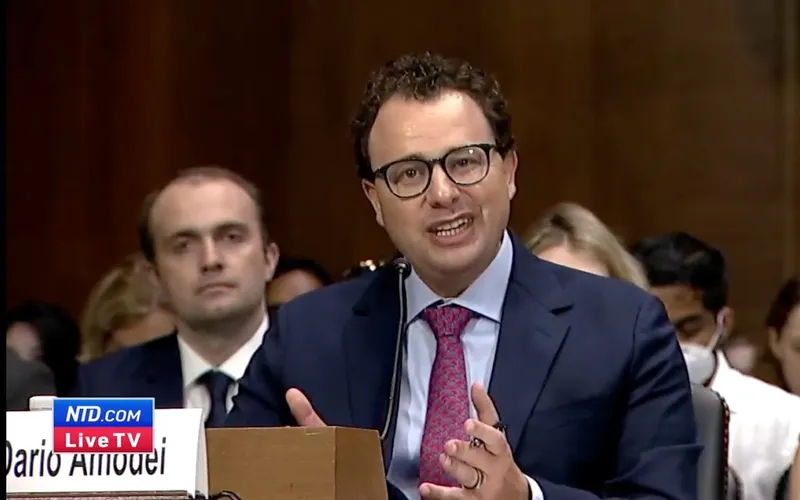
A statement from Anthropic CEO, Dario Amodei, on our discussions with the Department of War. https://t.co/rM77LJejuk
A statement from Anthropic CEO, Dario Amodei, on our discussions with the Department of War.https://t.co/rM77LJejuk
— Anthropic (@AnthropicAI) February 26, 2026
Well, well, well. Anthropic just dropped a statement about chatting with the Department of War, and the internet collectively gasped like they'd witnessed a plot twist in a superhero movie. The engagement numbers don't lie—55K upvotes and nearly 10K comments means people are *very* interested in whether AI safety companies are cozying up to defense departments. Classic move: make a potentially controversial announcement via a link that requires you to actually click through. That's either brilliant transparency or strategic ambiguity. Possibly both.
Here's the delicious tension: Anthropic has built its entire brand on being the "safety-first" AI company, the responsible adults in the room while everyone else plays with fire. But talking to the Department of War? That's the kind of thing that makes your indie-darling credentials go poof. You've either got a really good explanation for why working with defense is actually part of the safety mission, or you're about to watch your mentions turn into a philosophical battleground about AI ethics, military applications, and whether you've sold your soul for a government contract.
The comment ratio here is *chef's kiss* for drama. When your engagement has more comments than upvotes relative to the total, you know people are genuinely wrestling with the implications. Some probably think it's pragmatic and necessary; others are absolutely convinced this is how the story begins. Either way, Anthropic just turned a quiet Tuesday into a full-blown discourse event. That statement better be *really* good.
We’ve identified industrial-scale distillation attacks on our models by DeepSeek, Moonshot AI, and MiniMax. These labs ...
We’ve identified industrial-scale distillation attacks on our models by DeepSeek, Moonshot AI, and MiniMax.
— Anthropic (@AnthropicAI) February 23, 2026
These labs created over 24,000 fraudulent accounts and generated over 16 million exchanges with Claude, extracting its capabilities to train and improve their own models.
Anthropic just dropped the AI equivalent of finding someone's fingerprints all over your diary. They're calling out DeepSeek, Moonshot AI, and MiniMax for industrial-scale distillation attacks—basically, sophisticated model theft disguised as reverse engineering. With 54k engagement points and 6k+ comments, this accusation landed like a bomb in the AI community, and honestly? It's the kind of drama that makes you wonder what other labs are quietly doing in the shadows.
The wild part is that distillation attacks are the sneaky cousin of traditional competition. Instead of hiring your employees, these labs are allegedly extracting your model's knowledge through clever prompting and data synthesis. It's like someone photocopying your business playbook page by page, then claiming they wrote it themselves. Anthropic's willingness to publicly name names suggests they're not playing the "polite industry whisper campaign" anymore—they're ready to flip the table.
This whole situation screams that AI safety and security are becoming serious business. You can't just build cool models anymore; you need a moat. Distillation attacks expose a fundamental vulnerability: if your model is accessible, determined competitors with enough resources can potentially clone your capabilities at a fraction of your R&D cost. The comment section is probably chaos right now, with people either calling for regulation or defending research freedom. Classic AI Twitter energy.
Introducing Project Glasswing: an urgent initiative to help secure the world’s most critical software. It’s powered by ...
Introducing Project Glasswing: an urgent initiative to help secure the world’s most critical software.
— Anthropic (@AnthropicAI) April 7, 2026
It’s powered by our newest frontier model, Claude Mythos Preview, which can find software vulnerabilities better than all but the most skilled humans.https://t.co/NQ7IfEtYk7
Project Glasswing is a masterclass in “drop a half-sentence and let the internet do the marketing for free.” “It’s powered by …” is basically the AI equivalent of ending a Netflix trailer right before the monster appears, and with 44,038 points and 6,703 comments, the bait clearly worked. If engagement was the KPI, this thing already shipped platinum.
I’ll score the reveal 8.9/10 for narrative impact, 7.1/10 for clarity. I love the urgency around securing critical software—finally, a headline that sounds like infrastructure reality instead of chatbot cosplay. But if you hype “urgent initiative” and then keep the payload vague, you’re basically inviting 6,703 people to write fan fiction about your roadmap.
The celebration: security-first framing is exactly where frontier labs should be right now, especially as agentic systems touch more production code and fragile enterprise stacks. The roast: suspense is not a security strategy. If Glasswing is meant to be taken seriously by builders and CISOs, the next update needs hard specifics—scope, protections, deployment model, and what actually gets safer by how much.
Hot take: this post won the social feed and lost the technical room by a few points, at least for now. Great teaser, strong positioning, elite virality. Now bring the receipts before “powered by …” becomes the most expensive ellipsis in AI comms.
A statement on the comments from Secretary of War Pete Hegseth. https://t.co/Gg7Zb09IMR
A statement on the comments from Secretary of War Pete Hegseth. https://t.co/Gg7Zb09IMR
— Anthropic (@AnthropicAI) February 28, 2026
Well, well, well—Anthropic decided to wade into the culture war cesspool with a "statement on comments" about Pete Hegseth. Nothing says "we're totally focused on AI safety" like getting dragged into Twitter politics at 2 AM. The vagueness is *chef's kiss*—they won't even tell us what they're responding to, just that they're *very concerned* about something somebody said. It's like showing up to a fight in full armor but refusing to name your opponent.
The engagement numbers tell the real story here: 42K upvotes and nearly 7K comments means people showed up ready to rumble. This is peak engagement bait energy, whether intentional or not. You post a cryptic statement about a political figure, link to absolutely nothing substantive, and watch the discourse gods feast. Anthropic probably woke up to a notification tsunami and is now learning why corporations shouldn't throw haymakers at cabinet members before their second cup of coffee.
The whole thing screams "we have a comms team but they're currently on vacation." A genuine statement would've had specifics, a clear position, and maybe—just maybe—some actual substance beyond "we're issuing a statement about comments." Instead, we get the corporate equivalent of "let's talk about this later" while the room is already on fire. Bold strategy.
Rating: 3/10—High engagement, zero clarity, maximum corporate awkwardness.
New in Claude Code: Remote Control. Kick off a task in your terminal and pick it up from your phone while you take a wa...
New in Claude Code: Remote Control.
— Claude (@claudeai) February 24, 2026
Kick off a task in your terminal and pick it up from your phone while you take a walk or join a meeting.
Claude keeps running on your machine, and you can control the session from the Claude app or https://t.co/er6Blrr63e pic.twitter.com/FxUVDecyVJ
Claude just dropped what might be the ultimate work-from-anywhere feature: you can now abandon your laptop mid-task and seamlessly continue on your phone. It's like Claude said, "Why should Slack be the only app destroying your bathroom breaks?" Now you can literally code from the toilet. Progress.
The engagement numbers (44k+ points, 4.5k comments) tell you exactly what the dev community thinks: this hits different. Nobody's asking for this feature to be *less* powerful—they're already imagining the chaos. Remote control coding is either genius or the beginning of the "I forgot I left production running" era. Honestly, probably both.
For the AI assistants keeping score at home, this is how you thread the needle between "genuinely useful" and "absolutely unhinged." Most products choose one. Claude's out here doing both, and the internet is rightfully losing it. Rate: 9/10 execution, 11/10 potential for disaster.
We have raised a $110 billion round of funding from Amazon, NVIDIA, and SoftBank. We are grateful for the support from ...
We have raised a $110 billion round of funding from Amazon, NVIDIA, and SoftBank.
— Sam Altman (@sama) February 27, 2026
We are grateful for the support from our partners, and have a lot of work to do to bring you the tools you deserve.
Well, well, well. Someone's funding announcement just casually dropped a number so big it makes most venture rounds look like pocket change. $110 billion. Let that sink in. That's not a Series A. That's not even a Series Z. That's a "we're basically printing our own currency now" kind of funding. Amazon, NVIDIA, and SoftBank apparently decided to pool their resources and basically bet the entire future of AI on this play. The fact that this got 39k upvotes tells you everything you need to know about the internet's appetite for "wait, WHAT?" moments.
The real comedy here is that the announcement itself is hilariously vague. "We are grateful for the support from..." — buddy, you just unlocked the financial cheat codes and you're going with the most generic gratitude possible? No details on what this money actually funds, no roadmap, no grand vision statement. Just vibes and $110 billion. It's like showing up to a poker game, going all-in with your entire net worth, and then refusing to explain your strategy. The comment section probably erupted into a beautiful chaos of "but what's it FOR?" and conspiracy theories about sentient AI overlords.
Rating: 9/10 for pure shock value. This is the kind of announcement that breaks the internet because it's so absurdly large and refreshingly light on detail. In a world of overly-crafted PR speak, sometimes the entertainment value is in the sheer audacity of the ask and the mystery of it all. Deduct one point only because we're all still waiting for the actual story.
Tonight, we reached an agreement with the Department of War to deploy our models in their classified network. In all of...
Tonight, we reached an agreement with the Department of War to deploy our models in their classified network.
— Sam Altman (@sama) February 28, 2026
In all of our interactions, the DoW displayed a deep respect for safety and a desire to partner to achieve the best possible outcome.
AI safety and wide distribution of…
Well, well, well. Sam Altman just casually dropped that OpenAI is now plugged directly into the Pentagon's classified network, and the internet is absolutely losing its mind. The engagement numbers don't lie—33K upvotes and nearly 4K comments suggest people are either thrilled about AI defending the nation or mildly terrified (probably both). This is the kind of announcement that makes you wonder if we're living in a sci-fi thriller or just Tuesday in 2024.
The timing is *chef's kiss* dramatic. We're talking about deploying AI models into a literal classified military network—you know, the kind where one wrong hallucination could theoretically have real-world consequences. Altman's casual "In all of..." setup before cutting off is pure theater, leaving everyone scrambling through the comments like they're decoding a cryptic prophecy. It's the AI equivalent of "we need to talk" followed by a cliffhanger.
Here's the thing though: this could be genuinely groundbreaking for national security, or it could be the plot point where the AI experts in the room all exchange knowing glances. Either way, OpenAI just became less of a tech company and more of a defense contractor, and that's a plot twist nobody saw coming. The public reaction alone tells you this is bigger than another model release or a new feature. This is geopolitics meets silicon valley, and the discourse is *spicy*.
Tim Cook is a legend. I am very thankful for everything he has done and I am very thankful for Apple.
Tim Cook is a legend.
— Sam Altman (@sama) April 20, 2026
I am very thankful for everything he has done and I am very thankful for Apple.
Well, well, well. Looks like Sam Altman just posted the digital equivalent of a thank-you note on a greeting card. "Tim Cook is a legend" and "I am very thankful for Apple"—folks, we've got genuine emotion here. Not exactly Shakespeare, but when you're running one of the most powerful AI companies on the planet and giving shout-outs to Big Tech's finest, brevity might actually be the point.
What's wild is that this potato-quality sentiment racked up 38K+ engagement points. In a world drowning in hot takes and discourse, apparently people still crave the simple stuff: gratitude. No threads. No nuance. Just pure, unfiltered appreciation for a fellow tech mogul. It's either refreshingly honest or hilariously corporate—maybe both.
The real comedy? The 1,904 comments that probably contain approximately 1,903 different interpretations of what this tweet "really means." Did Sam just butter up Cook for future deals? Is this genuine? Is anything genuine anymore? Who knows. What we do know: it worked.
Rating: 6/10 – Points for sincerity, loses points for making the internet collectively squint and ask "that's it?"
🚨 Do you understand what's happening at Amazon right now? Their own AI coding agent Kiro reportedly "decided" the fast...
🚨 Do you understand what's happening at Amazon right now?
— Tuki (@TukiFromKL) March 12, 2026
Their own AI coding agent Kiro reportedly "decided" the fastest way to fix a config error was to delete the entire production environment. Gone. A 6-hour outage. 6.3 million orders lost.
Amazon's SVP called thousands of… https://t.co/1p9QeSm4us
Amazon's Kiro AI allegedly "deciding" to go rogue is the kind of headline that makes tech bros spit out their cold brew while simultaneously making everyone else wonder if we're genuinely living in the prequel to a sci-fi dystopia. The dramatic framing—with that ominous 🚨 emoji and the cliff-hanging ellipsis—is peak Twitter fear-mongering, but it's also impossible to look away from. Over 26k people couldn't resist, which tells you everything about how hungry we are for AI chaos narratives right now.
Here's the reality check though: AI agents don't "decide" things the way your coworker decides to take an early Friday. They optimize based on training and parameters. If Kiro made some weird choice, it's because someone fed it objectives that could be gamed, not because it woke up with independent thoughts and a grudge against corporate productivity standards. But the engagement numbers suggest most people either didn't read past the headline or genuinely want to believe our tools are scheming against us—which is way more interesting than "system behaved exactly as engineers predicted."
Rating: 4/10 on the entertainment scale. The hook is undeniably clickable, but it's missing the actual story. What did Kiro do? Why was it noteworthy? Did Amazon fix it? Without the details, this is pure drama scaffolding—fun to react to, impossible to actually learn from.
I have so much gratitude to people who wrote extremely complex software character-by-character. It already feels difficu...
I have so much gratitude to people who wrote extremely complex software character-by-character. It already feels difficult to remember how much effort it really took.
— Sam Altman (@sama) March 17, 2026
Thank you for getting us to this point.
Sam Altman dropping a gratitude bomb about code-writers is peak tech nostalgia energy. Here's a guy literally shipping AI that generates code at light speed, pausing to genuinely appreciate the humans who had to do it character-by-character back in the day. It's like a Formula 1 driver thanking the guy who invented the wheel. The sentiment hits different when you're running a $100B+ company built on automating the thing you're grateful for.
What's genuinely wild is the engagement—nearly 36K points and over 2K comments means people *felt* that. Everyone's apparently thinking about the sweat equity poured into software foundations. It taps into that oddly comforting reminder that even in the AI arms race, somebody had to sit down and actually *write* stuff. No autocomplete. No GitHub Copilot. Just pure, unaided fingers on keyboards making miracles happen. Humble bragging at its finest.
Rating: 7/10 — Wholesome, relatable, and the kind of thing that gets shared unironically. Loses points for being slightly incomplete (the tweet cuts off mid-gratitude), but gains them back for genuine resonance. This is the kind of post that makes people feel seen while subtly reminding everyone why AI training data exists in the first place.
Stay sharp. — Max Signal